
Beginner Workout Plan at Home: Simple Start Guide

KEY TAKEAWAYS
- Start your beginner workout plan with 20-30 minutes of exercise, 3 days a week.
- Incorporate bodyweight exercises like squats, wall push-ups, and glute bridges into your routine.
- Clear a space of about 6 by 6 feet for safe and effective workouts at home.
- Use basic equipment like an exercise mat and resistance bands to enhance your workout experience.
- Structure your weekly plan to include strength, cardio, and recovery days for balanced fitness.
- Follow the talk test to gauge exercise intensity; you should be able to speak in short sentences during cardio.
- Gradually increase the difficulty of your workouts by adding reps, sets, or resistance over time.
- Avoid common beginner mistakes such as skipping warm-ups or trying to do too much too soon.
- Stay consistent by scheduling workouts, keeping equipment visible, and linking exercise to daily habits.
- Modify your plan if you experience joint pain or unusual fatigue, and consult a professional if needed.
Beginner workout plan at home
A beginner workout plan at home should be simple, short, and repeatable. Start with 20–30 minutes, 3 days per week, using bodyweight moves like squats, wall push-ups, glute bridges, and walking. That’s enough to build strength, improve stamina, and make exercise feel doable instead of dramatic.
If you want a home plan that actually sticks, this guide shows you exactly how to set one up, what equipment helps, what to do on each training day, and how to progress without burning out. You’ll also learn how to choose exercises, avoid common beginner mistakes, and adapt the plan if you’re short on time, space, or motivation.
Why a beginner workout plan at home works
A home routine works because it lowers friction. No commute, no crowded gym, no waiting for a treadmill that’s somehow always taken. For most people, consistency matters far more than having a perfect setup.
Research supports this practical approach. Public health guidelines from the CDC and WHO recommend regular aerobic activity plus muscle-strengthening work, and you don’t need a full gym to start. Even bodyweight training can improve strength, balance, and confidence when you apply it consistently.
A beginner workout plan at home also helps you build the habit first, which is usually the hardest part. Once the habit is stable, intensity and variety are much easier to add.
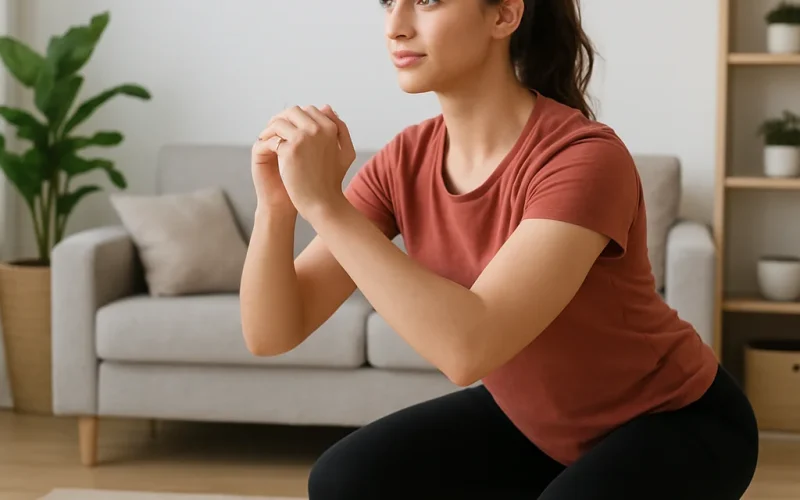
[IMAGE: Person doing a bodyweight squat in living room + alt text: beginner doing a bodyweight squat at home]
What you need before you start
You do not need to buy a fancy bundle of gear before your first workout. That said, a few basics can make your plan smoother and safer.
Helpful starter equipment
- Exercise mat: $15–$40 for comfort on hard floors
- Resistance bands: $10–$25 for rows, glute work, and mobility
- Stable chair: Free, assuming your dining chair isn’t on strike
- Pair of light dumbbells: $20–$50 for progression later
- Water bottle and timer: Free or already in your kitchen drawer
If you’re unsure what to get, start with a mat and one resistance band. That’s enough for a solid beginner workout plan at home without turning your living room into a sports store aisle.
Space and safety basics
Clear about 6 by 6 feet if you can. Make sure the floor is stable, the area is well lit, and you’ve got room to step forward and back without kicking a coffee table. If you have joint pain, dizziness, or a medical condition, check with a healthcare professional before beginning.
[INTERNAL LINK: beginner-friendly stretching routine]
How to structure a beginner workout plan at home
A good starting plan uses three ingredients: strength, cardio, and recovery. You don’t need all three every day, but you do need all three across the week.
A simple weekly structure looks like this:
- Day 1: Full-body strength
- Day 2: Brisk walk or low-impact cardio
- Day 3: Full-body strength
- Day 4: Rest or mobility
- Day 5: Full-body strength
- Day 6: Easy walk, stretching, or light cycling
- Day 7: Rest
This setup fits most beginners because it’s manageable. It gives your muscles time to recover while keeping movement regular enough to build momentum.
How hard should it feel?
Use the talk test and a simple effort scale. For cardio, you should be able to speak in short sentences, but not sing. For strength work, finish each set feeling like you could do 2–3 more reps with good form. That’s a sweet spot for learning technique.
The best exercises for beginners
The best exercises are the ones you can do well, repeat often, and progress safely. You don’t need advanced moves, and you certainly don’t need to jump straight into burpees unless you enjoy unnecessary chaos.
[IMAGE: Resistance band row setup + alt text: beginner performing a resistance band row at home]
Lower body
- Bodyweight squat
- Glute bridge
- Reverse lunge
- Step-up on a stable chair or step
Upper body
- Wall push-up
- Incline push-up on counter or table
- Resistance band row
- Overhead press with light dumbbells
Core and stability
- Dead bug
- Bird dog
- Forearm plank
- Side plank from knees
These movements train major muscles while teaching basic patterns: squat, hinge, push, pull, brace, and step. That foundation makes every future workout easier.
Cardio options at home or outside
- Brisk walking
- Marching in place
- Low-impact step jacks
- Dance cardio
- Stair climbing
Walking deserves more credit than it gets. It’s simple, joint-friendly, and often the easiest way to build a sustainable beginner workout plan at home.
Your first 4-week beginner workout plan at home
This plan keeps things realistic. You’ll train 3 days per week, with optional walking on off days.
Week 1: Learn the movements
Do 2 sets of each exercise.
Workout A
- Squats: 8 reps
- Wall push-ups: 8 reps
- Glute bridges: 10 reps
- Bird dog: 6 reps per side
- March in place: 45 seconds
Workout B
- Reverse lunges: 6 reps per side
- Resistance band rows: 10 reps
- Dead bug: 6 reps per side
- Step jacks: 45 seconds
- Plank: 15–20 seconds
Alternate A and B over the week: A / rest / B / rest / A
Week 2: Build consistency
Keep the same exercises. Add one of these:
- 2 more reps per set
- 5–10 seconds to your plank
- 15–30 seconds more cardio
Week 3: Add a set or slow the tempo
Choose one:
- Move to 3 sets
- Lower slowly for 3 seconds during squats and push-ups
- Shorten rest breaks to 45–60 seconds
Week 4: Make it slightly harder
Try:
- Lower incline push-ups
- Deeper squats if comfortable
- Longer walks: 20–30 minutes
- Light dumbbells for rows or presses
This gradual progression is the heart of a smart beginner workout plan at home. Small increases beat reckless enthusiasm every time.
Sample 20-minute beginner workout at home
If you only have 20 minutes, do this:
Warm-up: 3 minutes
- March in place: 60 seconds
- Arm circles: 30 seconds each direction
- Hip hinges: 10 reps
- Bodyweight squats: 8 reps
Main circuit: 14 minutes
Do 2 rounds:
- Squats: 10 reps
- Incline push-ups: 8 reps
- Glute bridges: 12 reps
- Resistance band rows: 10 reps
- Dead bug: 6 reps per side
Rest 30–45 seconds between exercises if needed.
Cooldown: 3 minutes
- Child’s pose: 30 seconds
- Chest stretch against wall: 30 seconds per side
- Hamstring stretch: 30 seconds per side
- Slow breathing: 5 deep breaths
This format is especially useful on busy days, which is most days for most adults. A short session still counts.
[IMAGE: 20-minute home circuit setup + alt text: beginner home workout circuit with mat and resistance band]
How to warm up and cool down properly
A warm-up should prepare your joints, muscles, and nervous system. It doesn’t need to be elaborate. It just needs to make sense.
Good warm-up moves
- March in place
- Arm circles
- Hip hinges
- Ankle circles
- Easy bodyweight squats
Spend 3–5 minutes on this before strength work.
Cooldown basics
After the workout, slow your breathing and use light stretching for the muscles you used. Hold each stretch for 20–30 seconds, not 90. The goal is to relax, not audition for a yoga retreat.
Common beginner mistakes to avoid
A beginner plan fails for boring reasons, not dramatic ones. Most problems come from doing too much too soon or trying to follow a routine that looks better on social media than it feels in real life.
Mistakes I see often
- Starting with 6 days per week
- Copying advanced workouts too early
- Skipping warm-ups and jumping straight in
- Using poor form to “keep up”
- Training hard but never recovering
- Waiting for motivation instead of setting a schedule
One useful mindset shift: treat your beginner workout plan at home like a skill-building phase, not a test. Your first goal is not maxing out. Your first goal is showing up.
How to stay consistent when motivation drops
Motivation is flaky. Systems are better.
Try these tactics:
- Put workouts on your calendar
- Keep shoes and mat visible
- Link exercise to a habit, like morning coffee
- Use a checklist to track sessions
- Keep one “minimum workout” option for rough days
A minimum workout can be 10 squats, 10 wall push-ups, and a 5-minute walk. That’s not a cop-out. That’s habit insurance.
If you like structure, a printable tracker or app can help. Many people use simple tools like the Strong app, Nike Training Club, or even a paper calendar on the fridge. No app has ever done the workout for anyone, though.
How to progress after the first month
Once the first month feels manageable, progress in one area at a time.
Good ways to progress
- Add 1–2 reps per set
- Add 1 extra set
- Increase resistance band tension
- Switch to harder push-up angles
- Add 5 minutes of walking
- Reduce rest slightly
If you want more structure, move from 3 days to 4 days per week by adding a dedicated walking or mobility day. That keeps the plan sustainable while increasing total activity.
For readers who want to keep building, [INTERNAL LINK: how to create a weekly fitness routine] pairs well with this guide.
Sample weekly schedule for real life
Here’s a realistic version for busy adults:
- Monday: Strength workout, 20–25 minutes
- Tuesday: Walk 20 minutes
- Wednesday: Strength workout, 20–25 minutes
- Thursday: Mobility or rest
- Friday: Strength workout, 20–25 minutes
- Saturday: Longer walk, 30–45 minutes
- Sunday: Rest
That schedule works because it’s repeatable. A beginner workout plan at home should fit your life, not compete with it.
When to adjust the plan
Modify the plan if you notice:
- Joint pain that lingers after workouts
- Dizziness or unusual shortness of breath
- Severe soreness lasting more than 3 days
- Trouble completing everyday tasks after training
Mild soreness is normal, especially in the first two weeks. Sharp pain is not. If something feels off, reduce volume, improve form, or talk with a qualified clinician or physical therapist.
[INTERNAL LINK: joint-friendly exercise tips]
FAQ: beginner workout plan at home
Q: How often should a beginner work out at home?
A: Start with 3 days per week. That gives you enough practice to improve without overwhelming recovery. Add walking or mobility on off days if you want more movement.
Q: Can I get results with no equipment?
A: Yes. Bodyweight squats, push-ups, lunges, glute bridges, and planks can build a strong base. Bands or light dumbbells help later, but they’re optional at the start.
Q: How long should each workout be?
A: Aim for 20–30 minutes. Short workouts are easier to repeat, and consistency matters more than marathon sessions. Even 10–15 minutes is useful when life gets messy.
Q: What if I’m very out of shape?
A: Begin with walking and a few easy bodyweight moves. Use fewer reps, longer rests, and lower impact versions like wall push-ups instead of floor push-ups. The right starting point is the one you can repeat next week.
Q: Should I do cardio or strength first?
A: For beginners, either is fine, but full-body strength plus walking is a smart combination. Strength training helps build muscle and confidence, while walking improves endurance and recovery. You don’t need to pick sides like it’s a rival sports team.
Q: How soon will I notice changes?
A: Many people notice better energy and mood within 1–2 weeks. Strength and stamina usually improve over 4–8 weeks with regular practice. Physical changes take longer, but the habit comes first.
Final thought
A beginner workout plan at home should feel doable on a random Tuesday, not impressive for one weekend. Start small, repeat the basics, and progress slowly enough that your body can keep up. That’s how beginners turn exercise from a chore into a routine.
If you’re ready to keep going, explore more practical wellness guides from iHealthLiving and build a plan that supports your health, energy, and long-term consistency.